فارسی
31 Dec 2025
  • Home
  • Regions
    • Central Asia
    • Afghanistan
    • Pakistan
  • issues
    • Political
    • Security
    • Economic
    • Social and cultural
  • Publications
    • Special reports
Event > Afghanistan
recommended
3
ISKP
Mapping ISKP attacks in Afghanistan
Since 2021, the security dynamics of Afghanistan have changed significantly. The Taliban, which was previously considered the main security threat in Afghanistan, has now become the ruling power. Meanwhile, Islamic State of Khorasan Province (ISKP) has become the main threat. Although anti-Taliban armed groups are also part of the new Afghan security dynamics, the threat posed by ISKP is more prominent than other dynamics, due to its nature and goals.
Mapping ISKP attacks in Afghanistan
Since 2021, the security dynamics of Afghanistan have changed significantly. The Taliban, which was previously considered the main security threat in Afghanistan, has now become the ruling power. Meanwhile, Islamic State of Khorasan Province (ISKP) has become the main threat. Although anti-Taliban armed groups are also part of the new Afghan security dynamics, the threat posed by ISKP is more prominent than other dynamics, due to its nature and goals.

The Institute for East Strategic Studies 

Javid Hosseini and Samaneh Akhgari*

Since the Taliban came to power in Afghanistan, the most significant threat facing this government has been ISKP. In the last two years, ISKP has expanded its attacks beyond Afghanistan, and its scope of activity has become regional.

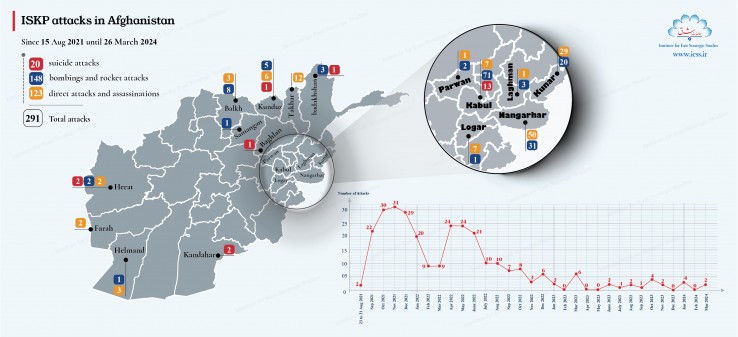
Given the importance of Afghanistan’s geography and the impact of its security developments on neighboring countries, as well as the regional threats posed by Islamic State of Khorasan Province, the IESS Afghanistan Working Group regularly monitors and records the group’s attacks. The results of this monitoring are published in the form of infographic maps.

The latest map published here covers ISKP activity up to Nov 15, 2025 ,with 315 recorded attacks.


Click here to see the high-quality map.

*Researcher fellows at the Institute for East Strategic Studies.

News code:2821

Share document
Author : Javid Hoseini Researcher at the Institute for East Strategic Studies (IESS)
Source : East Studies
Your Name

Your Email Address
Your Comment *


Articles

​The New Coalition of "National Alignment for the Future of Afghanistan": Opportunities and Challenges
​Trump
​Trump's Central Asian Thaw: From Impracticalism to A new prospect
The Possible Transition of Afghanistan from the South Asian Order to the Eurasian One
​Central Asia’s View of a Possible U.S. Return to Bagram

Interview

Central Asia
Central Asia's responses to the US-Israel Aggression against Iran
The Establishment of Jolani’s Government in Syria: Implications for Central Asia
Arab States and Taliban Government: Approaches and Relations
GCC-Central Asia developing relations: Opportunities and challenges
 
'
  • links
  • Contact Us
  • About us
  • Archive
Advanced Search
Copyright (c) Institute for East Strategic Studies, all rights reserved.
Powered by ”News Studio“