From periphery to bridge: Central Asia's rising role in Iran's "Look East" policy
East Studies , 18 Jan 2026 - 10:25
The achievements of the Iranian President’s recent visit to Kazakhstan and Turkmenistan were quite significant at the political and functional levels. However, the most important output of this constructive political approach was the “re-designation the image of Iran’s foreign policy in terms of Central Asia.” This proves that these outputs are not merely “achievements” and “results” but also a “starting point” and a “renewed opportunity” for Iran to make up for the last ten years of stagnation in its relations with Central Asia.
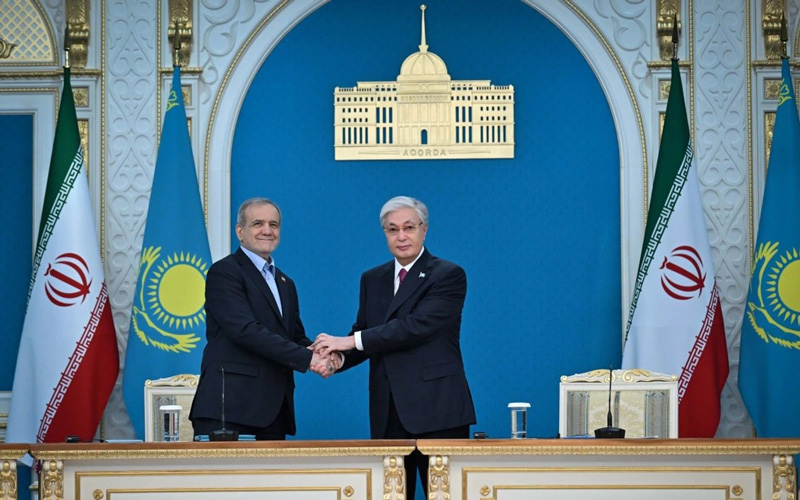
the President of the Islamic Republic of Iran, Dr. Masoud Pezeshkian, undertook a regional visit to Central Asia from 10 to 11 December. He first traveled to Astana at the invitation of Kassym-Jomart Tokayev, the President of Kazakhstan, during which a number of bilateral documents and agreements were concluded. Subsequently, on 11 December, Dr. Pezeshkian traveled to Ashgabat to participate in the International Conference on Peace and Trust, held on the occasion of the anniversary of Turkmenistan’s permanent neutrality. On the sidelines of this conference, important meetings were also held with senior officials of Turkmenistan and other countries, including Russia. At the same time, the Seventh Joint Consular Commission with Tajikistan was held in Dushanbe, with the presence of a political delegation from the Ministry of Foreign Affairs of Iran.
Under these circumstances, many Western and even Russian media outlets considered the coincidence of the Ministry of Foreign Affairs delegation’s visit and the President’s trips to Central Asia as Iran’s response to Kazakhstan’s membership in the Abraham Accords. However, in a realistic approach, these meetings can be considered as a positive political strategy centered on restoring Central Asia's position in the Iran’s strategic Look East policy. This strategic assessment seeks to evaluate this situation through a pathology-oriented perspective based on Dr. Pezeshkian’s recent visit to the region.
Over approximately 15 months of activity by the Fourteenth Government of Iran, under the presidency of Dr. Pezeshkian, 20 foreign visits at the highest level have been carried out, of which four trips were devoted to Central Asia —two visits to Turkmenistan, one official visit to Tajikistan, and one official visit to Kazakhstan. Taken together, this is noteworthy for a region such as Central Asia. During this period, other Iranian officials, including the First Vice President and the Minister of Foreign Affairs, also undertook numerous and frequent trips to Central Asia.
Within the framework of the President’s recent visit to Astana, important documents were signed by the two countries. During the official meetings with Kazakh officials, 14 cooperation documents were signed and exchanged between the two sides, indicating a tangible upgrading of bilateral relations. At the same time, significant symbolic actions were taken, such as the organization of an exhibition of historical documents related to the presence and interactions of Iranians with the inhabitants of the Central Asian region, which received extensive feedback. Moreover, the President’s visit was widely reflected in Kazakh TV channels, Online media, and social media platforms.
In Turkmenistan as well, Dr. Pezeshkian met and held talks with Gurbanguly Berdimuhamedov, the Chairman of the People's Council of Turkmenistan, and Serdar Berdimuhamedov, the President of Turkmenistan, during which important issues related to bilateral relations were raised and pursued.
Nevertheless, the experience of bilateral relations in previous visits and even in earlier administrations reveals realities that sometimes overshadow these achievements. Previously, during presidential meetings and high-level delegation visits between Iran and Central Asian countries, numerous documents and agreements had also been signed. In the trips of the late President Raisi to Tashkent and Dushanbe, 17 and 18 cooperation documents were signed, respectively, and during the 2018 and 2014 visits of President Rouhani to Ashgabat and Dushanbe, 13 and 10 cooperation documents were signed, respectively. However, the majority of these cooperation documents and agreements were either not implemented, or, if implementation began, they did not fully achieve their intended outcomes. Even in some cases where these agreements were fully implemented, they had no tangible results in bilateral relations. This situation has gradually altered the view of Central Asian countries toward cooperation with Iran, and this approach has emerged as a “mental structural barrier” in Iran’s relations with these countries.
One of the most important examples of this issue is the roadmap for developing trade exchanges to three billion dollars, which was prepared for implementation during Dr. Pezeshkian’s recent visit to Astana. Previously, some trade discussions and documents had been concluded between Iran and Kazakhstan, such as an agreement on trade worth $10 billion in 2008, agreements on trade worth $5 billion in 2014 and 2015, and an agreement on trade worth $3 billion between Iran and Kazakhstan in 2022. However, after 17 years since these agreements and statements, according to the Tehran Chamber of Commerce statistics in 2024, the total trade exchanges between the two countries amounted to only 339.7 million dollars.
This case study of trade relations, which is one of the simplest levels of relations between two countries (compared to political convergence or security and defense cooperation), clearly shows that despite the existence of political will at the leadership level, the necessary pragmatism for implementing agreements has been lacking within the executive bodies of both governments. More importantly, the absence of a “feedback mechanism” for the implementation of bilateral agreements as well as the “lack of regular repetition of political leaders’ meetings” has constituted a serious obstacle to correcting this situation.
Despite this significant structural weakness, it must be noted that the current conditions of the Islamic Republic of Iran (following the stalemate in nuclear negotiations with the West and as a result of the consequences of the 12-day aggression by the Zionist regime) has led to an understanding: that paying attention to Central Asia within the framework of the "neighborhood policy" should still be considered as a "pragmatic approach"— at the macro level as an "inevitable requirement" and in the 14th Iranian government as an "executive strategy."
This has led to the formation of an important redesigned image at the external level, along with internal reformist approaches, and so has reduced the impact of the aforementioned “mental structural barrier”, at least in the short term.
Dr. Pezeshkian’s official visit to Dushanbe last year as well as his visit to Turkmenistan to participate in a Conference on the birth anniversary of Magtymguly Fragi, and more recently, his visits to Astana and Ashgabat have generated numerous political and international reactions. A significant portion of these reactions originated from the West with the aim of creating challenges and controversies (such as linking these visits to Kazakhstan’s membership in the Abraham Accords). However, a more important portion of this feedback was through the indigenous perspective of Central Asian hosts at the elite level, and especially among public opinion.
These reactions clearly demonstrate that the elites and public opinion of this region—and even the international community—have accepted Iran’s Look to Central Asia strategy and continue to regard it as a pragmatic approach. Although this approach has often materialized at the outset of new governments in Iran, it has now taken on more qualitative dimensions due to current international issues and the sensitive regional situation. Accordingly, a renewed opportunity has emerged to reform the structure of Iran–Central Asia relations, making it possible to compensate for approximately a decade of stagnation in these relations.
One of the most significant shortcomings in Iran’s strategic Look East policy is the “reductionist,” “particularistic,” and “negative” approaches toward it. While major regional and global actors such as India, the United Arab Emirates, Saudi Arabia, Turkey, Pakistan, and even the Zionist regime have also adopted look to the East policies through diverse approaches and strategic processes—most of which intersect in “interactions with Russia and China”—Iran’s particularistic approach cannot be effective.
The second shortcoming in this regard is the reductionist approach. Despite the dominance of Western-oriented tendencies in Iran’s domestic political discourses and internal Western-oriented approaches in foreign policy, the strategic Look East policy has been reduced merely to an “orientation toward the East,” or even more narrowly to the “improvement and development of relations with Russia and China.” This is while, at least at the discursive level of the Islamic Republic of Iran’s foreign policy, the Look East strategy signifies a form of “structural non-Westernism” in relations—such that at the internal level it creates a balance against the dominant Western-oriented current, and at the regional and international levels establishes a degree of balance and “positive resistance” against the powerful Western-centric hegemonic current.
The third shortcoming is the focus on negative dimensions, centered on the costly strategy of “anti-Westernism” with “revisionist” and “deconstructive” behaviors, which is fundamentally at odds with the Look East policy. The reality is that the emerging non-Western world, within structures such as BRICS or the Shanghai Cooperation Organization (SCO), seeks to enhance the position of the non-Western world within the existing order that was itself created by the West. The primary challenge in this process is the West’s own “self-destructive” actions. In other words, non-Western powers such as Russia and China are striving to preserve the current structure of the global order against the actions of the United States and Europe, in order to destroy it; examples of which can be observed in Western approaches to delegitimizing the UN Security Council or dismantling WTO-based trade regimes under Trump.
A noteworthy point that has received less attention is the convergence of these three shortcomings in Central Asia as a strategic discursive annex to Iran’s Look East policy. A pragmatic and strategic policy framed as a Look to Central Asia can significantly correct all three shortcomings.
First, within the framework of reviving Iran’s position amid the emerging competitions of regional and international powers in Central Asia and the new patterns of friendship and rivalry formed in this region—under the concept of the “multi-dimensional Great Game”—the particularistic nature of this policy can be reduced.
Second, through presence and the creation of strategic depth in Central Asia, Iran can avoid limiting the Look East policy solely to China and Russia (and define Central Asia as a key strategic dimension of it), while also developing a process of “leveraging” vis-à-vis emerging Eastern powers to achieve more balanced relations in the future.
It should not be forgotten that Central Asia is the intersection point of the strategic and even vital interests of Russia and China at levels such as national security. Achieving strategic depth in this region can guarantee the sustainability of relations with these countries and moderate their divergent and balancing behaviors toward other countries, such as their positions on Iran’s three islands.
Finally, Central Asia represents the most significant example of a sustainable balance within a multilateral foreign policy at the global level. Improving relations with these countries and even involving them in regional and international political processes (especially in interactions with the West) can strengthen the positive dimensions of Iran’s Look East policy and diminish its negative aspects. Conclusion
The achievements of Dr. Pezeshkian’s visit to Kazakhstan and Turkmenistan at the political and functional levels were relatively significant; however, the most important outcome of this constructive political approach was the “re-designation of Iran’s foreign policy image in terms of Central Asia.” This demonstrates that these outcomes are not only “achievements” or “results,” but also a “starting point” and a “renewed opportunity” for Iran to compensate for the stagnation of the past decade in its relations with Central Asia.
One solution for sustaining and strengthening this reformist trend and increasing the level of pragmatism in relations with Central Asia is the discursive attachment of this policy to the Look East strategy. Tehran is compelled to view Central Asia as a strategic bridge for balancing and ensuring the long-term sustainability of its strategic partnership with Moscow and Beijing.
From this perspective, creating a strategic depth in Central Asia is an “inevitable necessity” in Iran’s Look East policy. If such a strategy is not implemented and this strategic depth is not created against rivals such as Turkey, the United Arab Emirates, and even the Zionist regime, we should witness further instability in Iran's relations with Russia and China in the not-too-distant future. Therefore, Tehran must place several key approaches on its agenda:
• Adding Central Asia to Iran’s foreign policy priorities; • Allocating the necessary resources for this new position, both materially and in soft-power dimensions; • Defining bilateral political dialogues at the leadership level on a regular basis and sustaining them beyond ceremonial interactions, through personal diplomacy and as a structural aspect of foreign policy; • Establishing a pathology and reform mechanism at the macro level, centered on upstream institutions such as the Expediency Discernment Council, to pursue the stabilization of the growth of relations with Central Asia; • and Promoting discourse-building for the development of relations with Central Asia within the executive body of the government, especially among mid-level managers, in order to reduce the existing contradictions in Iran’s foreign policy as perceived from the Central Asian perspective.
Under such conditions, it can be expected that the current golden opportunity in relations with Central Asia will be preserved, and its results will gradually manifest in the future achievements of the government and other governing structures.
Omid Rahimi, is a researcher at the Institute for East Strategic Studies (IESS)

 QR code